Get Mold Remediation Near Texas Parkway — Free Estimate
Mold on a property along the Texas Parkway (FM 2234) corridor — a retail or office unit, a civic building, or a home in the central subdivisions the parkway connects? We remediate it fast and contained, commercial or residential. We trace the rooftop HVAC, roof, or plumbing source, contain the area under IICRC S520 protocol, remove the mold, and verify the air. Serving the Texas Parkway corridor in 77489 with a free estimate.
The Mold We Remediate Along the Texas Parkway Corridor
Texas Parkway — FM 2234 — is the central spine through Missouri City, passing the civic core near City Hall at 1522 Texas Parkway and connecting the central subdivisions on either side. The buildings on it span retail and office frontage, civic structures, and residential access, and the mold problems track the building type. On the commercial, office, and civic side, the leading cause is rooftop HVAC condensate: a clogged condensate drain or a failing pan that runs water into the ceiling assembly above an occupied space, growing mold in the cavity before the stained tile gives it away. Close behind are flat-roof leaks on the low-slope roofs and restroom and shared-wall plumbing — common in higher-traffic civic and office buildings — that wet a concealed wall.
On the residential side, Texas Parkway connects established central Missouri City neighborhoods, where homes bring the standard Gulf Coast pair: attic mold from humidity and roof leaks, and master-bath mold from under-ventilated showers. Whatever the building, the method holds. We isolate the work area with 6-mil polyethylene sheeting and run negative air so spores can't migrate — the rest of the building or home stays clean — and we never disturb a dark, possibly black-mold patch without containment. Every job starts with a proper mold inspection to find the source and scope exactly what's contaminated before any cutting, the same source-first approach behind all of our mold remediation Missouri City work. This page anchors to the parkway corridor as a whole; the civic building at the City Hall node has its own anchor, and for the full city picture see mold remediation in Missouri City.
What Happens When We Come to the Texas Parkway Area
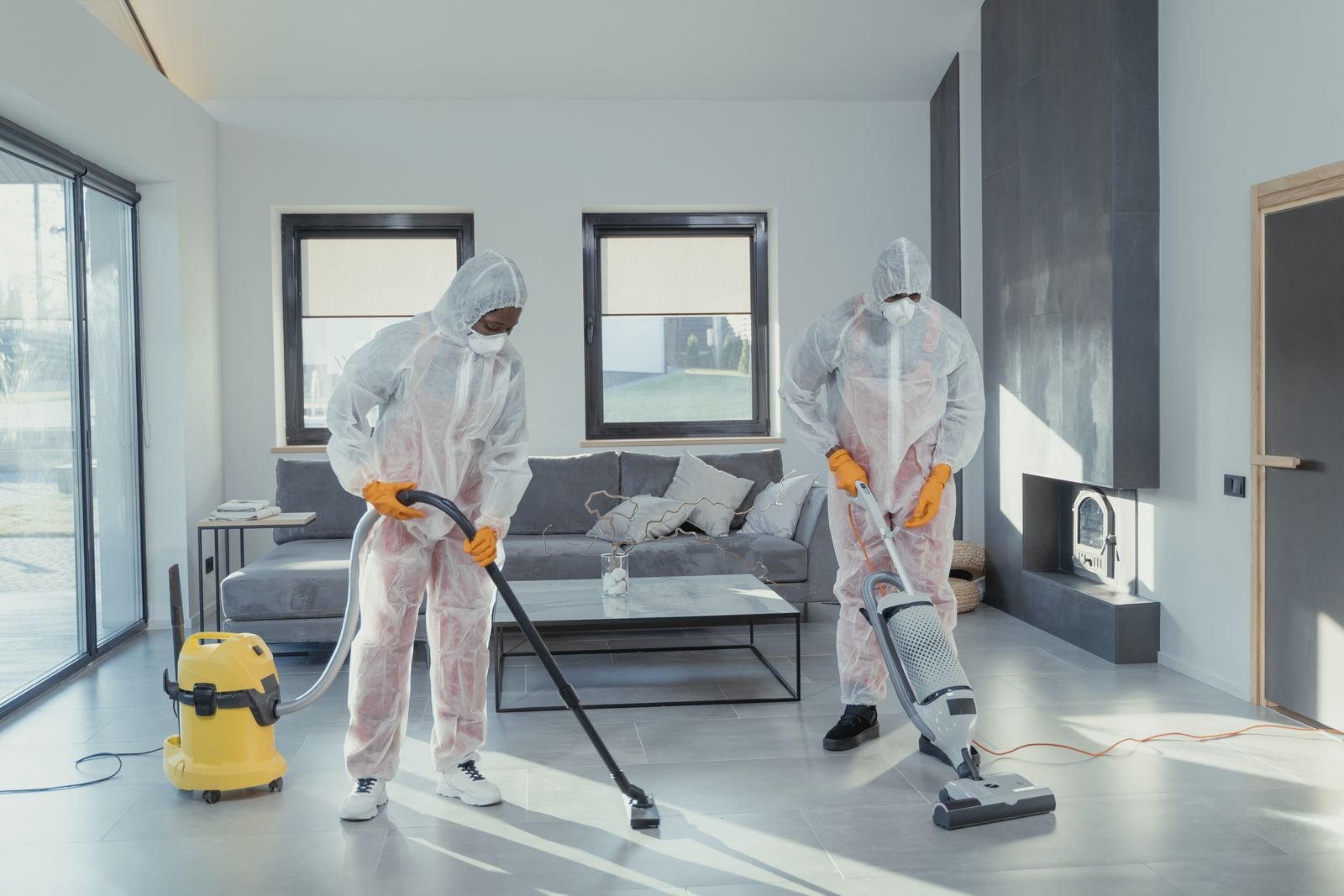
The IICRC S520 sequence, in order — whether it's a corridor unit, a civic building, or a central home.
- Inspect and find the source. We map the affected area with moisture meters and thermal imaging and trace it to the rooftop HVAC condensate, the flat-roof leak, the restroom or shared-wall plumbing, or the attic or bath driving it — nothing holds if the water keeps coming.
- Contain the work zone. We seal the area with 6-mil poly sheeting and run a negative-air machine at -5 to -10 pascals, with HEPA filtration capturing 99.97% of particles at 0.3 microns, so spores stay inside the containment and out of occupied space.
- Remove the contaminated material. Colonized porous material — drywall, ceiling tile, insulation, carpet pad — is cut out and bagged inside the containment. Non-porous framing, deck, and metal are cleaned in place.
- HEPA-clean and treat. Surfaces are HEPA-vacuumed and wiped with an antimicrobial, and the air is scrubbed before anything reopens.
- Dry the structure. We dry the assembly back to a normal moisture content and target an indoor RH of 30–50%, because leftover dampness invites the colony back.
- Verify and clear. On a job over 25 square feet — common on commercial and civic spaces — an independent TDLR Mold Assessment Consultant confirms the indoor spore levels match or beat the outdoor baseline before the containment comes down, documented for your records or insurer.
Mold Remediation Cost Near Texas Parkway — and Your Free Estimate
Tenant, building manager, or homeowner, the first question is the number. Along the Texas Parkway corridor, mold remediation typically runs about $10 to $30 per square foot, and most local jobs land between roughly $1,500 and $6,000. A contained ceiling around a single HVAC leak is at the low end; black mold or mold spread through a larger commercial or civic assembly sits higher because of the added containment and protective equipment. A standalone inspection, where one is needed, runs about $300 to $1,075. Price tracks the job, which is why we scope it free before quoting:
- How much area is affected — a contained ceiling is very different from mold through a whole floor.
- Which materials are involved — porous drywall, ceiling tile, and insulation come out; non-porous surfaces are cleaned.
- Commercial/civic clearance — jobs over 25 sq ft need independent TDLR clearance, which we coordinate.

Why Properties Along Texas Parkway Get Mold
It starts with the climate. Missouri City and the wider Fort Bend area run roughly 74% ambient relative humidity for much of the year, so mold here is a standing risk that any leak or condensation event can trigger. Once water intrudes, mold growth begins within 24 to 48 hours — an HVAC pan overflow or a restroom leak can seed a colony in a hidden assembly within two days. Holding indoor relative humidity in the 30 to 50% range slows it; above 60%, conditions favor growth.
Then the building type decides the failure mode. The commercial, office, and civic structures along Texas Parkway concentrate risk in rooftop HVAC and its condensate lines, low-slope flat roofs prone to ponding, and the higher-traffic restroom and shared-wall plumbing those buildings run — any of which can wet a concealed cavity and grow mold out of sight. The central residential neighborhoods the parkway connects carry the standard attic-and-bath version. Across the corridor the lesson is identical — fix the moisture fast and dry properly and mold stays out; let water sit in this humidity and it grows. That's why every remediation we do on the corridor starts at the source.
Central Areas Texas Parkway Connects
We cover the Texas Parkway (FM 2234) corridor in 77489 — the retail, office, and civic frontage along the parkway, including the City Hall node at 1522 Texas Parkway, plus the central subdivisions the corridor connects. For orientation on the parkway itself, see the Texas Parkway anchor, and for the full service map, mold remediation in Missouri City.
Confirm Coverage — Call NowFrequently Asked Questions
Common questions from Texas Parkway owners, managers, and residents — answered straight.
Mold on a Texas Parkway Property? Let's Fix It Right.
Contained, IICRC S520 remediation for corridor retail, office, civic buildings, and the central homes the parkway connects — we find the source, remove the mold, and verify the air. Free estimate, no pressure.
(713) 325-6192Get Mold Remediation Near Texas Parkway.
Fast, contained work for commercial, civic, and residential properties on the FM 2234 corridor — with a free phone estimate and clearance documentation. Talk to a certified specialist now.
(713) 325-6192Call for a Free Estimate